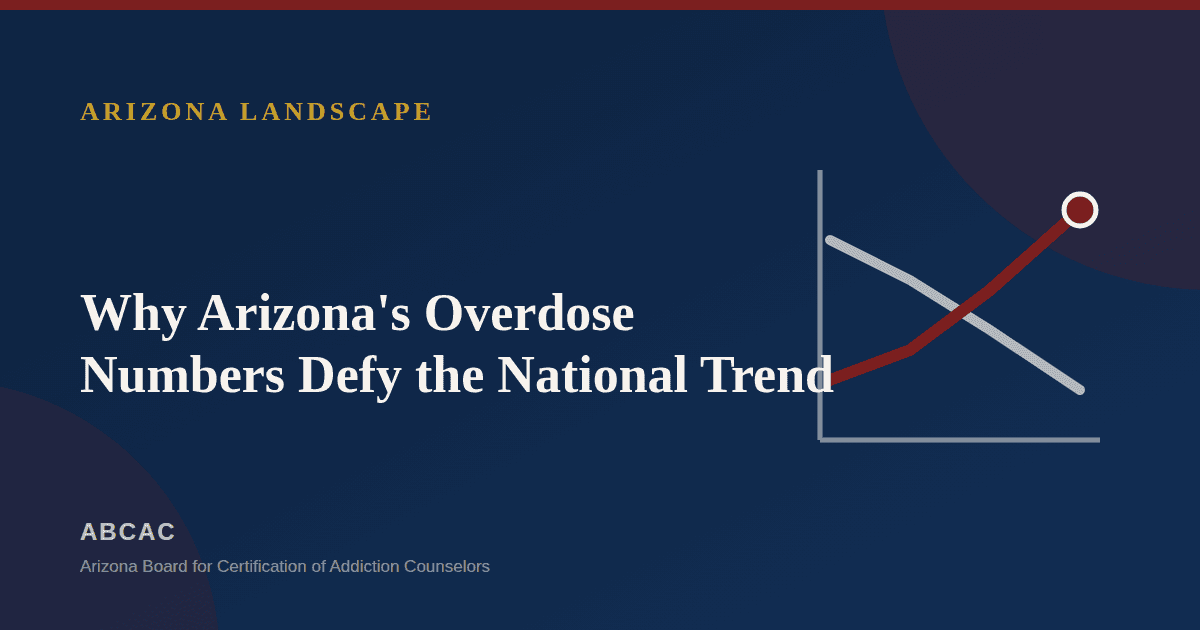
For the first time in years, there's genuinely good news in the national overdose data — a sharp, sustained decline that some researchers are calling a turning point in the crisis. But if you work in behavioral health in Arizona, you may not recognize that story. That's because Arizona is going the other way.
The national trend and the Arizona trend have split, and understanding why matters for anyone doing this work in our state.
The national picture: a real decline
The numbers nationally are striking. U.S. overdose deaths fell about 27% in 2024 — from roughly 110,000 the year before to around 80,400 (provisional CDC estimates) — driven largely by a big drop in fentanyl-related deaths. Preliminary data suggests the decline continued into 2025, with national deaths falling further to around 70,000.
Researchers have been cautious but hopeful. One Brown University epidemiologist described it as a possible fundamental change in the arc of the overdose crisis — not just a blip. After years of relentless increases, that's a remarkable shift.
The Arizona exception
Arizona didn't join the party. According to Arizona public-health analyses, the state's overdose deaths rose about 18% from 2024 to 2025 — from roughly 2,531 to 2,988. A peer-reviewed analysis found that Arizona deaths in the first eight months of 2025 (about 2,034) were roughly 20% higher than the same period in 2024 (about 1,689), with several months in early 2025 setting records.
Arizona wasn't alone, but it was in rare company. The CDC identified only a handful of states bucking the national decline — Arizona, New Mexico, and Colorado among the states seeing increases of 10% or more. In a year when most of the country was finally exhaling, the Southwest, and Arizona in particular, was still climbing.
What's driving it
The full explanation is still being worked out, but the Arizona data points to a few threads:
- Synthetic opioids kept rising. While fentanyl deaths dropped nationally, Arizona saw synthetic-opioid deaths increase — by roughly a third in the relevant period.
- Stimulants are a huge part of the story. Methamphetamine is involved in a majority of Arizona overdose deaths, and cocaine-involved deaths rose sharply (on the order of 70%). This is not only a fentanyl crisis in Arizona — it's a polysubstance one.
- The "fourth wave." Nationally and locally, overdoses increasingly involve combinations — fentanyl plus stimulants — which are harder to reverse and harder to treat.
Who's being hit hardest
The Arizona increases have not been evenly distributed. The analyses found the rise most pronounced among Hispanic and Black Arizonans — a reminder that the overdose crisis tracks along existing lines of disparity in access to treatment, harm-reduction resources, and culturally responsive care.
For counselors and program leaders, that's not an abstract statistic. It's a directive: the communities carrying the heaviest burden are the ones where outreach, culturally competent care, and harm-reduction access need to be strongest.
What this means for Arizona professionals
If you work in Arizona behavioral health, the split between the national and state trends has practical implications:
- Don't assume the national good news applies to your caseload. Locally, demand and risk are still rising.
- Plan for polysubstance reality. Fentanyl-plus-stimulant patterns require assessment and intervention strategies that go beyond a single-substance model.
- Prioritize the communities most affected. The disparities in the data should shape where outreach and resources go.
- Lean into harm reduction and effective treatment. Naloxone access, fentanyl and xylazine test strips, and evidence-based treatments (including contingency management for stimulant use) are exactly the tools this moment calls for.
The takeaway
The country may be turning a corner on overdose deaths, but Arizona is a genuine outlier — deaths rose roughly 18% from 2024 to 2025, driven by synthetic opioids, a heavy stimulant burden, and polysubstance use, and falling hardest on Hispanic and Black Arizonans. The national headlines are encouraging; Arizona's reality is more urgent. For professionals here, that gap is the whole point: this is not the time to relax. It's the time to double down.
This article reflects provisional overdose data from CDC, Arizona public-health sources, and peer-reviewed analyses available as of early 2026. Provisional mortality figures are routinely revised as investigations are completed; treat specific numbers as estimates and consult the latest data from the Arizona Department of Health Services and CDC for current figures.