Arizona needs addiction counselors — badly. The state is facing rising overdose deaths, a stubborn workforce shortage, and growing demand for behavioral health services. If you're thinking about entering this field, you're stepping into work that matters and a job market that wants you.
But the path can look confusing from the outside, largely because of one thing beginners almost always mix up: licensure and certification are two different systems. This roadmap walks you through both, in order, so you know exactly what to do first.
Step 0: Understand the two tracks
Before anything else, internalize this:
- Licensure (from the Arizona Board of Behavioral Health Examiners, AZBBHE) is the legal authorization to practice, diagnose, and bill in Arizona. To work independently, you need it.
- Certification (from the Arizona Board for Certification of Addiction Counselors, ABCAC, an IC&RC member board) is a voluntary, portable credential that employers value and that transfers across state lines.
You may pursue one, the other, or both. Most serious addiction-counseling careers involve licensure at minimum. Keep this distinction in your head as you read the rest.
Step 1: Get the right education
Your degree determines where you start on the licensure ladder:
- Associate degree in addiction / behavioral health with a counseling emphasis → points toward the entry LACT license.
- Bachelor's degree in a behavioral science → points toward the LAAC (associate) license.
- Master's degree or higher → the path to the independent LIAC license.
A few practical notes:
- For licensure, AZBBHE generally requires university-based classroom instruction for its education hours. For certification, ABCAC accepts approved distance and self-study education. That difference can shape which programs you choose.
- Look for programs with recognized accreditation (for example, NASAC-accredited addiction-studies programs or regionally accredited institutions), which tend to align well with credential requirements.
- Plan your coursework against your target credential's specific education hours so nothing is wasted.
Step 2: Accumulate supervised experience
Both tracks require supervised, hands-on experience — and this is where a lot of your timeline lives.
- For licensure, each rung has its own experience requirement. The independent LIAC, for example, requires at least 1,600 hours of direct client contact over a minimum of 24 months (no more than 400 in psychoeducation), plus a supervisor's competency attestation.
- For ABCAC certification, the hour requirements vary by credential — for instance, the bachelor's-level CADAC calls for substantial supervised experience in the IC&RC domains.
The universal rule: make your hours count. Confirm before you start that your supervisor is qualified and that the hours you're logging satisfy the requirements for the credential you actually want. Keep meticulous records — hour logs and supervisor attestations are exactly what the boards review.
A shortcut for new grads: HB2001
Arizona created a helpful on-ramp. Under HB2001 (effective September 26, 2025), qualifying recent graduates can practice under supervision for a 90-day window while their associate-level license application is pending — and those hours count toward licensure. That means you may be able to start earning supervised experience (and a paycheck) sooner than you'd expect. Confirm your eligibility, but don't overlook it.
Step 3: Pass your exam
For addiction-counseling licensure, AZBBHE accepts a board-approved exam — the IC&RC exam (ADC or AADC), a NAADAC exam, or an NBCC exam, depending on your level and discipline.
Here's a strategic tip: if you want both licensure and ABCAC certification, choosing the IC&RC exam can let a single exam serve both goals, since ABCAC is an IC&RC member board. Plan your exam choice around your full set of credential goals, not just the immediate one.
The most common entry exam, the IC&RC ADC, is 150 questions (125 scored), scored 200–800 with a passing line of 500, built on four weighted domains. It's a real exam with a meaningful failure rate — study to the domain weights and use the official IC&RC candidate guide.
Step 4: Apply for your license and/or certification
- Licensure: Submit your application to AZBBHE with your transcripts, supervised-hour documentation, and exam results. Remember that licensure carries ongoing obligations — Arizona's Statutes & Regulations Tutorial plus ethics/law/cultural-competency CE at each renewal.
- Certification: Apply to ABCAC for the credential that matches your level (CAC, CADAC, AADC, or a specialty credential). Certification renews every two years and requires continuing education (for most credentials, 40 clock hours every two years, including ethics and cultural-diversity hours).
On ABCAC fees: Published fees for ABCAC application, certification, and reciprocity should be confirmed directly with ABCAC — the current figures are best verified at the source before you budget.
Step 5: Land your first job
The good news: Arizona's workforce shortage means demand for qualified addiction counselors is strong, and the field is projected to keep growing. As you job-hunt:
- Target settings that match your credential level. Entry roles often welcome LACT/LAAC-level counselors under supervision; independent roles want the LIAC.
- Highlight both your license and your certification. Many Arizona treatment providers specifically value ABCAC certification.
- Consider where the need is greatest — rural and tribal communities, and programs funded by Arizona's opioid-settlement dollars, are actively building capacity.
Set expectations on pay realistically for the entry phase (Arizona's median wage for substance-use, behavioral-disorder, and mental-health counselors was around $49,920 as of May 2024), and know that advancing up the license ladder and adding certifications increases both your authority and your earning potential.
Your roadmap at a glance
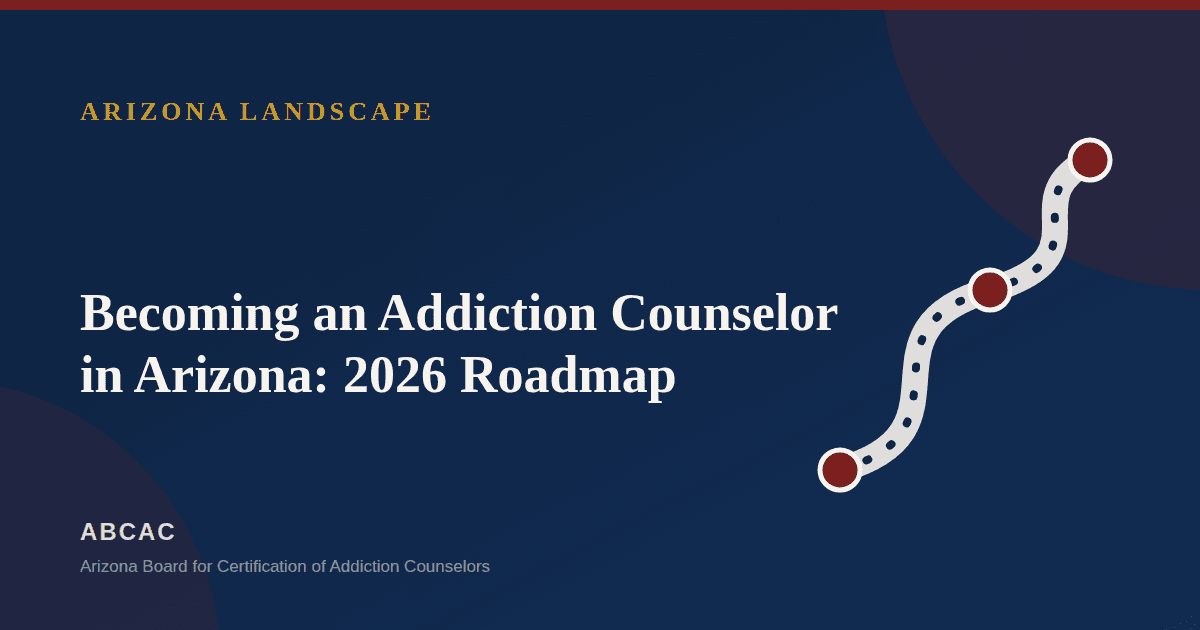
- Understand the two tracks — licensure (required to practice) vs. certification (voluntary, portable).
- Get the right education for your target credential.
- Accumulate supervised hours that actually count — and use HB2001 if you qualify.
- Pass your exam — choose IC&RC if you want licensure and certification to share one exam.
- Apply to AZBBHE (license) and/or ABCAC (certification).
- Land a job in a field that genuinely needs you.
The takeaway
Becoming an addiction counselor in Arizona is a clear, achievable path once you separate the two systems: get your license from AZBBHE to practice legally, and add ABCAC/IC&RC certification to strengthen and mobilize your career. Match your education and hours to your target credential, choose your exam strategically, and take advantage of on-ramps like HB2001. Arizona is short on counselors and long on need — there's real room here for people ready to do the work.
Ready to start?
Requirements, hours, and fees change — especially after recent legislation like SB1062 and HB2001. Before you enroll in a program or begin logging hours, confirm current requirements directly with AZBBHE (bbhe.az.gov) for licensure and ABCAC (abcac.org) for certification.
This article is educational and not legal or career advice. Verify all current requirements with the relevant boards before making decisions.