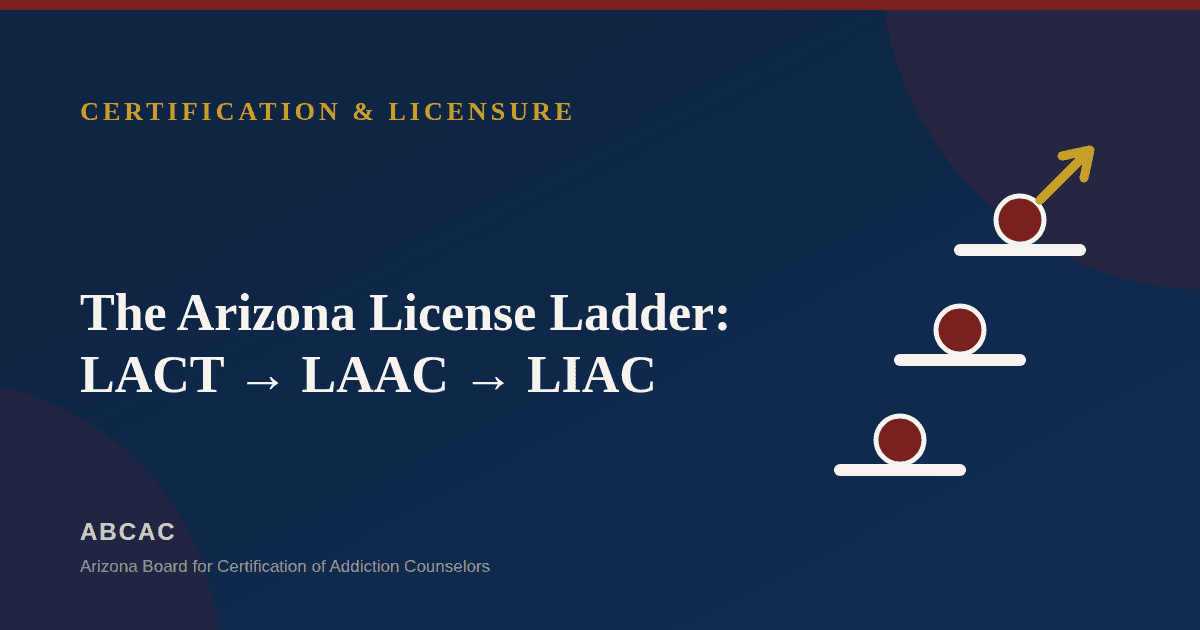
Arizona doesn't hand out one addiction-counseling license — it has three, and they form a ladder. Where you start depends on your degree; where you end up depends on your experience and your goals. Understanding the full ladder before you take your first step saves you from the most common (and expensive) mistake: earning hours or coursework that don't count toward the rung you actually want.
Here's how the Arizona Board of Behavioral Health Examiners (AZBBHE) structures the climb.
First, a quick vocabulary update
If you've been in the field a while, you learned these licenses as LSAT, LASAC, and LISAC. Arizona renamed them under SB1062, effective September 14, 2024:
- LSAT → LACT (Licensed Addiction [Counselor] Technician)
- LASAC → LAAC (Licensed Associate Addiction Counselor)
- LISAC → LIAC (Licensed Independent Addiction Counselor)
Same ladder, new names — plus a broader scope that now covers behavioral (process) addictions, not just substances. Existing licensees re-designate to the new titles at renewal.
Rung 1: LACT — the technician license
The LACT is the entry point. It's designed for people who have foundational education but not yet a full clinical degree.
- Education: typically an associate degree in addiction/behavioral health with a counseling emphasis, or a bachelor's degree in a behavioral science.
- Scope: dependent, supervised practice. You work under supervision and cannot practice independently.
- Best for: people entering the field who want to start accumulating supervised experience while they pursue a higher degree.
Think of the LACT as the license that gets you in the room doing supervised clinical work legally.
Rung 2: LAAC — the associate license
The LAAC is the bachelor's-level associate credential.
- Education: a bachelor's degree plus qualifying supervised experience.
- Scope: supervised practice — a step up in responsibility, but still under a qualified supervisor.
- Best for: bachelor's-prepared counselors building toward independent licensure, or those whose career plan tops out at the associate level.
The LAAC is where many counselors spend the phase of their career during which they're accumulating the direct-client-contact hours they'll need for the top rung.
Rung 3: LIAC — the independent license
The LIAC (formerly LISAC) is the one that changes everything. It's the license that authorizes independent practice — the ability to diagnose, treat, and supervise on your own authority.
- Education: a master's degree or higher in a qualifying field.
- Experience: at least 1,600 hours of direct client contact over a minimum of 24 months (with no more than 400 of those hours in psychoeducation), plus a supervisor's attestation of your competency.
- Scope: independent practice — you can diagnose, treat, bill, and supervise others.
A note on the numbers: Because SB1062 recently reworked these licenses, you'll still find older sources citing a "3,200 total / 1,600 direct" formula. The current statute anchors on 1,600 direct-contact hours over 24+ months. Always verify against the current version of A.R.S. § 32-3321 before you count on a specific figure.
The LIAC is the goal for anyone who wants to run their own practice, diagnose independently, or supervise the next generation of counselors.
The exam question
For addiction-counseling licensure, AZBBHE accepts a board-approved exam — and it recognizes more than one option. Depending on your level and discipline, that means the IC&RC exam (ADC or AADC), a NAADAC exam, or an NBCC exam. This is worth planning around: if you also want ABCAC certification, choosing the IC&RC exam can let one exam serve both goals. (More on that in our exam guides.)
Note that Arizona doesn't require a separate stand-alone jurisprudence exam before licensure — but it does require an Arizona Statutes & Regulations Tutorial plus continuing education in ethics, behavioral-health law, and cultural competency at every renewal.
Climbing the ladder: how the rungs connect
The smartest way to approach the ladder is to plan the whole climb before you take the first step:
- Match your degree to a starting rung. An associate degree points to LACT; a bachelor's to LAAC; a master's to LIAC.
- Make your supervised hours count. Confirm that the hours you're logging — and the supervision you're receiving — satisfy the requirements for your target license, not just your current one.
- Pick your exam strategically. If certification portability matters to you, the IC&RC route can do double duty.
- Keep your paperwork clean. Supervisor attestations, hour logs, and education transcripts are what the board actually reviews. Sloppy records are the single most common cause of delays.
The takeaway
Arizona's LACT → LAAC → LIAC ladder is a genuine career pathway, not just a set of parallel licenses. Each rung expands what you're legally allowed to do, culminating in the independent authority of the LIAC. Know where you're starting, know where you're going, and make every hour and every credit count toward the top of the ladder.
Planning your climb?
The requirements above reflect Arizona law as of early 2026, but supervised-hour and education rules change — especially in the wake of SB1062. Confirm the current details against A.R.S. § 32-3321 and the AZBBHE rules (A.A.C. Title 4, Chapter 6) before you enroll in a program or begin logging hours.
This article is educational and not legal advice. Verify all requirements directly with AZBBHE at bbhe.az.gov.