If you're building a career in addiction counseling in Arizona, there's a single point of confusion that trips up more new professionals than any other: certification and licensure are not the same thing. They're issued by different organizations, they mean different things legally, and mixing them up can cost you a job offer, a billable service, or months of wasted effort.
Let's clear it up for good.
The short version
- Licensure comes from the Arizona Board of Behavioral Health Examiners (AZBBHE). It is the legal authority to practice, diagnose, and bill for behavioral health services in Arizona. If you want to work independently, this is not optional.
- Certification comes from the Arizona Board for Certification of Addiction Counselors (ABCAC), an IC&RC member board. It's a voluntary professional credential focused on substance use counseling that's recognized across state lines through IC&RC's reciprocity network.
ABCAC itself puts it plainly: its certification is a voluntary credential recognized internationally through IC&RC, while AZBBHE licensure is a state-issued legal requirement for independent practice — the thing that actually lets you diagnose, treat, and bill for services in Arizona.
One is a legal license. The other is professional recognition. You can hold both, and many counselors do.
What licensure (AZBBHE) actually gives you
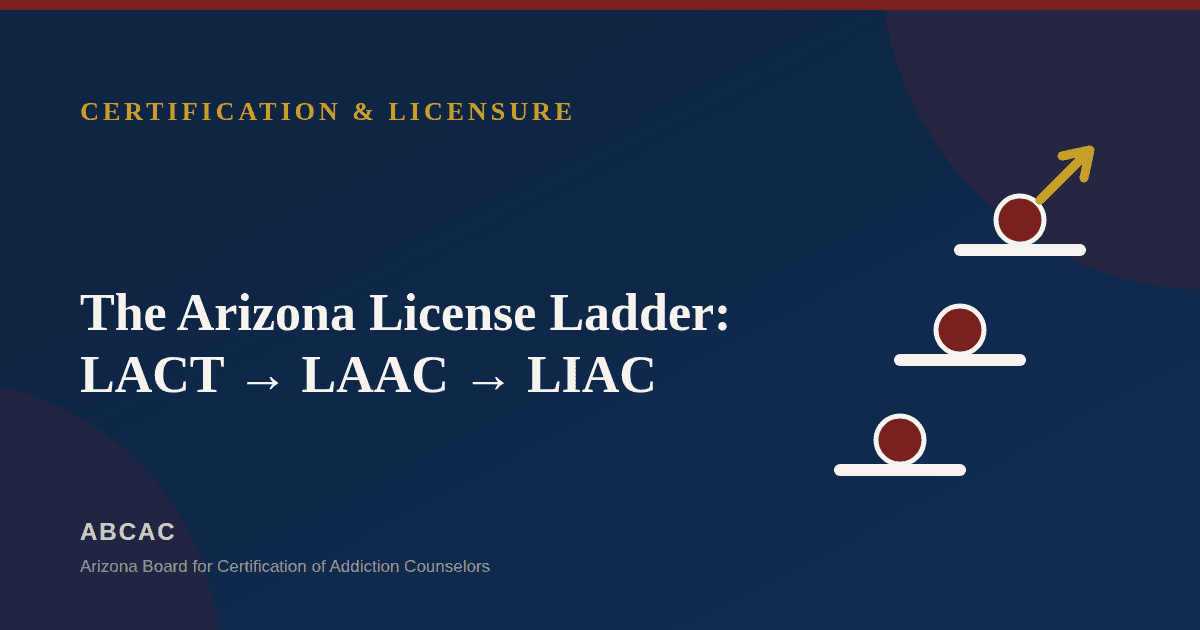
The AZBBHE license is what the state of Arizona checks before you can independently assess, diagnose, treat, and bill. Arizona's addiction-counseling license ladder has three rungs:
| License | Level | Typical education | Practice authority |
|---|---|---|---|
| LACT (Licensed Addiction [Counselor] Technician) | Entry | Associate in addiction / bachelor's in a behavioral science | Dependent, supervised |
| LAAC (Licensed Associate Addiction Counselor) | Associate | Bachelor's + supervised experience | Supervised |
| LIAC (Licensed Independent Addiction Counselor) | Independent | Master's or higher + supervised hours | Independent — can diagnose and supervise |
Heads-up on titles: If you earned your license before late 2024, you may know these as LSAT, LASAC, and LISAC. Arizona renamed them under SB1062, effective September 14, 2024. Same board, new names — and a broader scope that now includes behavioral (process) addictions.
Licensure requires board-approved education, supervised experience, and a passing score on an approved exam (Arizona accepts IC&RC, NAADAC, or NBCC exams depending on your discipline and level). It also carries ongoing obligations: every renewal requires Arizona's Statutes & Regulations Tutorial plus continuing education in ethics, behavioral health law, and cultural competency.
What certification (ABCAC) actually gives you
ABCAC certification is a credential, not a license. It signals to employers, payers, and peers that you've met a nationally benchmarked standard in substance use counseling. ABCAC's credentials include:
- CAC — Certified Addiction Counselor (entry-level)
- CADAC — Certified Alcohol & Drug Abuse Counselor (bachelor's level)
- AADC — Advanced Alcohol & Drug Counselor (master's level)
- Plus specialty credentials: CCS (Clinical Supervisor), CCJP (Criminal Justice Professional), CPS (Prevention Specialist), and CPRS (Peer Recovery Support Specialist)
The biggest practical advantage of ABCAC certification is portability. Because ABCAC is an IC&RC member board, your reciprocal-level credential (CADAC and above) can transfer to other IC&RC states without starting from scratch. One important caveat: the entry-level CAC is not eligible for IC&RC reciprocity — only CADAC, AADC, and the reciprocal specialty credentials are.
So which one do you actually need?
Here's the honest answer: it depends on what you want to do.
- Want to independently diagnose, treat, and bill insurance in Arizona? You need an AZBBHE license. Certification alone won't authorize it.
- Work at an agency that prefers or requires certified counselors? You'll likely need ABCAC certification, and many Arizona treatment providers ask for it.
- Plan to move between states during your career? ABCAC certification with an IC&RC reciprocal credential makes that far smoother.
- Want the strongest possible profile? Hold both. The license makes you legal; the certification makes you portable and marketable.
The two systems also differ in the fine print. AZBBHE generally requires university-based classroom instruction for its education hours, while ABCAC accepts approved distance and self-study education. That difference matters when you're planning coursework, so map your target credential before you enroll in anything.
The takeaway
Think of it this way: licensure is permission; certification is proof. Arizona law cares about the license. Employers, payers, and other states increasingly care about the certification. Knowing which is which — and which you need for the career you're building — is the first real step toward doing this work well in Arizona.
Ready to map your path?
Before you invest in coursework or exams, confirm the current education-hour and supervised-hour requirements for your specific goal. Certification requirements and fees should be verified directly with ABCAC, and licensure requirements against the current Arizona statute and AZBBHE rules — both are updated periodically.
This article is for general educational purposes and reflects requirements as of early 2026. It is not legal advice. Always confirm current requirements with AZBBHE (bbhe.az.gov) and ABCAC (abcac.org) before making decisions about your credential.